
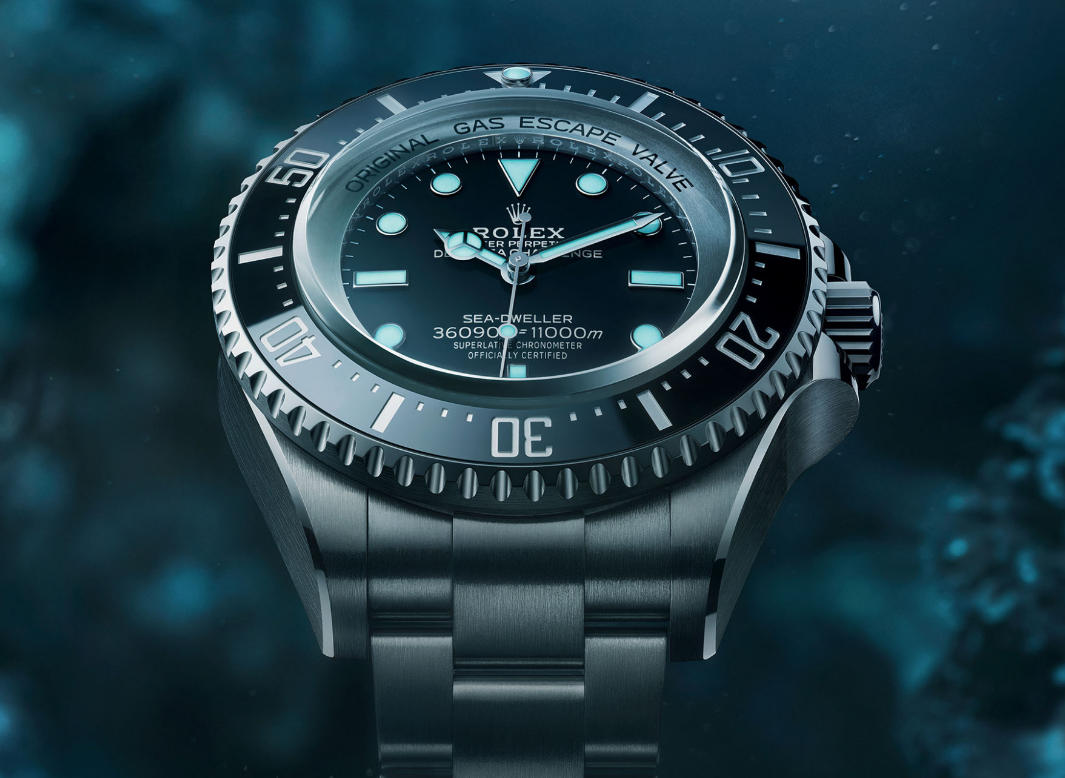
The Rolex Deepsea Challenge is one of the most difficult professional Rolex designs to reproduce convincingly. Its 50mm case, unusually thick sapphire crystal and distinctive pressure-resistant construction make it very different from the familiar Submariner and Sea-Dweller. At first glance, it may look like an oversized black diving watch, but its proportions and engineering give it a character of its own.
For readers interested in Rolex super clone watches, the reference 126067 deserves particular attention. This is the 50mm Deepsea Challenge, not the smaller 44mm Deepsea. That distinction matters because the case dimensions, crystal profile, bezel and bracelet all contribute to the appearance of the larger model. A replica can reproduce the familiar black dial and ceramic bezel, yet still look noticeably different if these components are not proportioned correctly.
Introduced in 2022, the genuine Deepsea Challenge was developed from Rolex’s long history of experimental deep-diving watches. By 2026, its appeal is no longer simply about being a record-breaking release. What makes it interesting is the combination of extreme dimensions, titanium construction and the Ringlock System. These are also the features that make a Rolex Deepsea Challenge super clone particularly challenging to assess.
The 50mm Case Is More Than a Size Specification
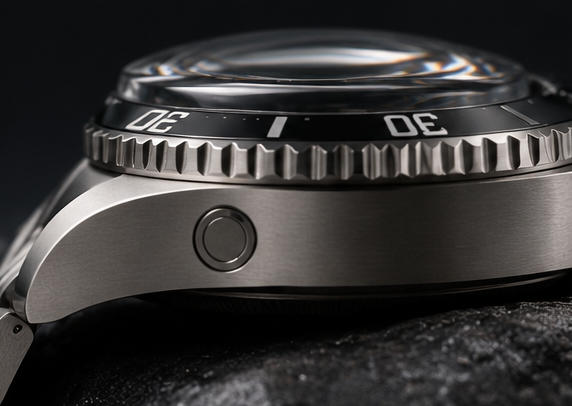
The first thing to understand about the Deepsea Challenge is that its 50mm diameter cannot be considered separately from its approximately 23mm thickness. Both dimensions define the watch. Unlike a conventional sports model, it has a substantial side profile, with a thick crystal, broad bezel and reinforced case construction. Even on a relatively large wrist, it occupies considerable space.
Rolex uses RLX Titanium for the genuine case and bracelet. This helps reduce the weight compared with an equivalent construction in stainless steel, making the watch more manageable despite its dimensions. The predominantly brushed finish also gives the original a distinctive technical appearance. It is not simply a grey version of a steel Rolex. The surface treatment and transitions between brushed and polished areas contribute to its identity.
When examining a 50mm Rolex Deepsea Challenge replica, the most revealing detail is often the side profile. The middle case should look substantial without appearing excessively bulky, while the crystal, bezel and caseback should form a balanced structure. If the crystal sits too high or the caseback adds unnecessary depth, the watch can look considerably thicker than the genuine reference.
The bracelet is equally important. The original Oyster bracelet uses solid titanium links and a substantial clasp incorporating the Oysterlock safety mechanism, Glidelock adjustment and Fliplock extension. These features are designed around the requirements of professional diving, but they also influence how the bracelet looks and fits. Poorly shaped end links, stiff articulation or an oversized clasp can make a replica feel less balanced on the wrist.
Material claims deserve particular care. A grey finish or lightweight appearance does not prove that a replica uses RLX Titanium. Unless the actual material composition can be verified, it is more accurate to discuss the surface appearance and construction rather than claim that it matches Rolex’s proprietary material specification.
Ringlock System Is the Hardest Detail to Reproduce
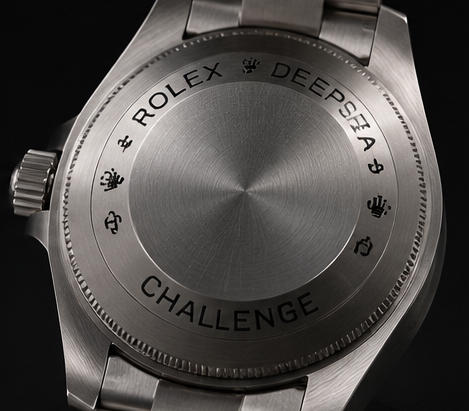
The defining engineering feature of the Deepsea Challenge is its Ringlock System. This is not simply a thicker watch case or a more substantial waterproof seal. The original construction combines a 9.5mm domed sapphire crystal, a nitrogen-alloyed steel compression ring and a titanium caseback. These components work together to withstand the enormous pressure associated with extreme underwater depths.
This is where external similarity and genuine engineering become two very different things. A replica may have a thick crystal and a caseback designed to resemble the original, but that does not establish that it contains the same internal compression structure. The Ringlock System cannot be verified through dial photographs or exterior markings alone.
The genuine reference is rated by Rolex to 11,000 metres of water resistance and tested to a pressure equivalent to 13,750 metres. These figures reflect a specialised engineering and testing process developed with COMEX. They should not be transferred to a Rolex Deepsea Challenge Ringlock replica simply because its external appearance is similar.
The helium escape valve is another recognisable feature. It is designed to release accumulated helium during decompression in saturation diving. Although its external position is relatively easy to identify, reproducing the appearance of the valve does not demonstrate that the mechanism works in the same way.
For this reason, the most useful way to assess a Deepsea Challenge super clone is to separate visible design details from technical claims. Crystal thickness, case proportions and external finishing can be compared visually. Internal pressure resistance, material properties and diving performance require proper independent testing. Without that evidence, no replica should be assumed safe for professional diving.
The Dial, Ceramic Bezel and Calibre 3230
The black dial is relatively restrained considering the size of the watch. Rolex uses no date window, leaving the hands and applied hour markers to provide a clean display. The Chromalight-filled markers produce a blue glow in darkness, while their different shapes help maintain the familiar professional Rolex layout.
This simplicity makes accuracy particularly important. The spacing between the markers, the length of the hands and the position of the printing all influence the dial’s appearance. On a replica, markers that are too large or hands that are incorrectly proportioned can make the face look crowded. These differences are easier to notice because there are relatively few decorative elements to distract the eye.
The black Cerachrom bezel is another important part of the design. Its unidirectional 60-minute scale uses platinum-coated graduations on the genuine model. The ceramic insert contrasts with the titanium case, while the knurled outer edge provides grip. A replica should be judged on the width of the insert, the alignment of the markings and the transition between the bezel and the case. An incorrectly proportioned bezel can make the dial appear smaller and change the entire balance of the watch.
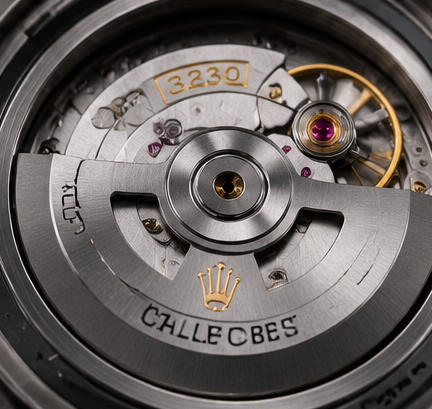
The genuine Deepsea Challenge uses Rolex Calibre 3230, an automatic time-only movement with an approximate 70-hour power reserve. Its construction includes the Chronergy escapement, Parachrom hairspring and Paraflex shock absorbers. The movement is also part of Rolex’s Superlative Chronometer testing programme.
Descriptions such as 3230 clone or Super Clone movement need to be treated separately from the genuine specification. A replica may use a different automatic calibre with similar external decoration, but that does not establish that it shares the architecture, accuracy or reliability of Rolex Calibre 3230.
When comparing a Rolex Deepsea Challenge 3230 replica movement, the actual operation matters more than decorative engraving. Winding behaviour, timekeeping consistency and the construction of the movement are more meaningful than a rotor carrying similar-looking markings. The original’s 70-hour power reserve and chronometer performance should not be attributed to a replica without independent evidence.
Readers interested in other Rolex models and their construction can also visit our Rolex Super Clone collection.
What Makes a Better Deepsea Challenge Replica
The Deepsea Challenge is a useful example of why replica quality cannot be judged by one attractive product photograph. Its identity depends on the relationship between the case, crystal, bezel and bracelet. A convincing dial cannot compensate for an incorrectly shaped case, just as a well-finished bracelet cannot correct an oversized bezel or an excessively thick profile.
I would begin by examining the watch from the front and side. The 50mm diameter should be considered together with the overall height, crystal position and shape of the crown guards. Next, look at the bezel markings, dial alignment and hands. The bracelet should sit naturally against the case, with links that articulate properly rather than appearing stiff or poorly fitted.
The wearing experience also deserves attention. RLX Titanium makes the genuine watch lighter than a comparable steel construction, but its dimensions remain substantial. A replica made from a different material may feel considerably heavier. This is particularly relevant because the Deepsea Challenge is already a large watch before its bracelet and clasp are taken into account.
It is also worth looking beyond macro photographs. Close-ups can make printing and engraving appear impressive, but ordinary wrist photographs reveal much more about the actual proportions. The side profile, bracelet fit and relationship between the case and wrist are often more useful than another magnified image of the Rolex logo.
For UK readers comparing Rolex Deepsea Challenge super clone watches in 2026, the most sensible approach is to focus on what can genuinely be established. External design accuracy, finishing, dimensions and movement operation can all be examined individually. Claims about proprietary titanium, extreme water resistance or identical movement performance require evidence that cannot be supplied by appearance alone.
The Rolex Deepsea Challenge remains one of the most distinctive professional watches in the Rolex collection. Its 50mm RLX Titanium case, 9.5mm sapphire crystal, Ringlock System and substantial Oyster bracelet give it an identity that is difficult to confuse with an ordinary diving watch.
For anyone examining a Deepsea Challenge super clone, the important details are not simply the black dial and familiar bezel. Case proportions, crystal height, bracelet construction, finishing and the actual movement all deserve attention. These features determine whether a replica captures the character of reference 126067 or merely borrows its appearance.
The genuine Rolex remains the benchmark for the model’s engineering and performance. A replica should be assessed according to its own verifiable materials, construction and functionality, rather than being assigned the original watch’s specifications. Understanding that difference is what makes a proper comparison worthwhile.