

The Omega Constellation Observatory is one of the most technically interesting interpretations of the Constellation in recent years. Introduced in 2026, the collection combines design cues inspired by mid-century Constellation watches with a new approach to precision testing that allows a watch displaying only hours and minutes to achieve Master Chronometer certification.
For readers researching an Omega Constellation Observatory replica, however,the certification headline is only part of the story. The 39.4mm case, dog-leg lugs,dodecagonal pie-pan dial, faceted markers, Observatory medallion and Calibre 8914/8915 architecture all provide useful details for comparing different interpretations of the design.
What Is the Omega Constellation Observatory?
The modern Constellation Observatory collection was introduced in 2026 as a family of nine references. The watches deliberately move away from the rounded claws associated with many modern Constellation Manhattan models and instead revisit visual elements found on earlier Constellations from the 1950s and 1960s.
That historical connection matters because the Constellation has always been closely associated with precision. Omega launched the Constellation as its series-produced chronometer collection in 1952, and the Observatory name continues that relationship with chronometer testing.
The 2026 collection combines this heritage with modern dimensions and movement technology.Every launch reference uses the same basic 39.4mm format, while different materials, dial executions and movement finishing separate the individual models.
Omega Constellation Observatory Key Specifications
| Feature | Constellation Observatory |
|---|---|
| Introduction | 2026 |
| Launch references | 9 |
| Case diameter | 39.4mm |
| Case thickness | Approx. 12.23mm |
| Lug-to-lug | Approx. 47.2mm |
| Dial | Dodecagonal pie-pan design |
| Display | Hours and minutes |
| Steel movement | Omega Calibre 8914 |
| Precious-metal movement | Omega Calibre 8915 |
| Power reserve | Approx. 60 hours |
| Frequency | 25,200 vibrations per hour / 3.5Hz |
| Water resistance | 30 metres |
| Certification | Master Chronometer |
Why the Two-Hand Design Is Technically Important
At first glance, removing the seconds hand appears to simplify a watch. From a precision-testing perspective, however, it creates an unusual problem.
Traditional testing methods can visually monitor the position of a seconds hand and compare it with an external timing reference. A watch displaying only hours and minutes does not provide that same visible indication.
The Constellation Observatory therefore required a different testing approach. Rather than adding a seconds indication simply to make certification possible, Omega worked with the Laboratoire de Précision on a system capable of measuring the watch without depending on a visible seconds hand.
The result makes the minimalist two-hand display more than an aesthetic choice. It is directly connected to one of the most technically unusual aspects of the collection.
How the Acoustic Master Chronometer Testing Works
The testing method developed for the Observatory uses acoustic measurements together with optical hand tracking. Instead of relying exclusively on visually reading a seconds hand,the testing equipment can analyse the mechanical sound produced by the movement.
Environmental and performance data can then be monitored while the complete watch progresses through the certification procedure.
This made it possible for the Constellation Observatory to become the first two-hand watch collection to achieve Master Chronometer certification.
What this means for replica comparisons
A replica may reproduce the two-hand appearance and Master Chronometer wording, but those visual details should not be confused with the certification process applied to the original watch.
Movement appearance, movement performance and official certification are three separate areas that should be evaluated independently.

The Dodecagonal Pie-Pan Dial Is the Main Visual Signature
Perhaps the most recognizable vintage-inspired feature is the return of the pie-pan dial.
Rather than remaining flat from the centre to the perimeter, the dial transitions through twelve angular outer sections. Viewed from above, those facets create the characteristic dodecagonal geometry associated with classic Constellation designs.
Grooves across the faceted area add another layer of texture. Precious-metal versions use more elaborate dial finishing, while the O-MEGASTEEL references interpret the pattern through different production methods.
Dial details worth examining
- The geometry of all twelve pie-pan facets
- Depth between the central dial and outer sections
- Consistency and spacing of the decorative grooves
- Alignment of the applied hour markers
- Position of the Constellation star
- Shape of the hands
- Printing quality and logo alignment
These details matter because the dial depends strongly on symmetry. A small error in one facet or marker can affect the visual balance of the complete watch.
Black Ceramic, Blue, Green and Silver Dial Options
The O-MEGASTEEL range does not rely on one universal dial execution.
Blue and green versions provide more colour, while a silver-toned model offers a more restrained interpretation. One of the most technically distinctive references uses a glossy black ceramic
pie-pan dial.
Producing the sharp geometric profile in ceramic is considerably more complicated than simply creating a conventional flat ceramic surface.
For anyone comparing photographs of UK cheap super clone watches,the exact reference should therefore be established first. Dial colour, texture and finishing can legitimately differ across the collection, so comparing a green O-MEGASTEEL version against photographs of a gold or ceramic reference can lead to misleading conclusions.
Dog-Leg Lugs Bring Back a Classic Constellation Detail
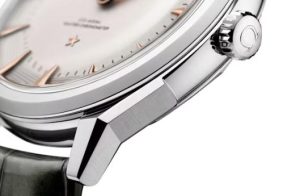
The case is another area where the Observatory looks back toward vintage Constellation design.Angular dog-leg lugs project from the central case with much more definition than the softer forms found on many contemporary dress watches.
Their geometry gives the 39.4mm case a distinctive profile and creates additional polished surfaces that react strongly to changing light.
Because of this, diameter alone is not enough when examining an Omega Constellation Observatory replica. Two watches can both measure around 39mm yet appear very different if the lugs, bezel or case sides use different proportions.
Case details worth comparing
- Overall 39.4mm diameter
- Dog-leg lug angle
- Lug thickness and taper
- Approximate 12.23mm case height
- Bezel width
- Polished and brushed surface transitions
- Caseback profile
- Relationship between the lugs and strap
Kite-Form Markers and Short Dauphine-Style Hands
The dial uses highly faceted applied hour indexes inspired by kite-like forms, accompanied by short, sharply defined hands.
These details help maintain the mid-century character without simply reproducing an old Constellation at vintage dimensions.
Their finishing also matters. Multiple polished surfaces can reflect light differently,making the indexes appear to change shape depending on viewing angle.
Useful points to inspect
- Marker length and width
- Consistency of the faceting
- Hour-marker alignment with the pie-pan sections
- Length of the hour hand
- Length of the minute hand relative to the outer track
- Polishing quality
Calibre 8914: The Movement for O-MEGASTEEL Models
The O-MEGASTEEL Observatory references use Omega Calibre 8914.
This is an automatic Co-Axial movement configured specifically for the two-hand display.It provides approximately 60 hours of power reserve and operates at 25,200 vibrations per hour.
Through the sapphire caseback, the movement also becomes an important part of the visual identity of the watch. The skeletonised rotor carries the Observatory motif, connecting the modern calibre with one of the historic symbols of the Constellation family.
When examining replica specifications, a movement advertised as “8914” should not automatically be assumed to reproduce the architecture of the original calibre. Marketing terminology,visual decoration and mechanical construction should be considered separately.
Calibre 8915: Precious-Metal Executions
Precious-metal Observatory models use Calibre 8915, which takes a more decorative approach to the same fundamental two-hand concept.
Depending on the execution, precious-metal elements appear in the balance bridge and rotor.Omega divides the movement finishing into Luxe and Grand Luxe interpretations.
The highest-level Platinum-Gold model receives particularly elaborate decoration around the Observatory medallion, combining several materials and finishing techniques.
| Feature | Calibre 8914 | Calibre 8915 |
|---|---|---|
| Primary application | O-MEGASTEEL | Precious metals |
| Functions | Hours, minutes | Hours, minutes |
| Winding | Automatic | Automatic |
| Power reserve | Approx. 60 hours | Approx. 60 hours |
| Main visual distinction | Rhodium-plated execution | Precious-metal decorative elements |
The Observatory Medallion Is More Than Decoration
The observatory-and-stars emblem has been associated with the Constellation since the early years of the collection.
On the new Observatory, Omega incorporates this motif into the skeletonised rotor visible through the sapphire caseback.
The design refers to Omega’s historic performance at observatory chronometer trials and reinforces the reason the collection carries the Constellation name.
Caseback details to compare
- Size and position of the Observatory medallion
- Star arrangement
- Rotor geometry
- Movement bridge layout
- Engraving sharpness
- Depth visible through the sapphire back
- Finishing appropriate to the exact reference
O-MEGASTEEL vs. Precious-Metal Constellation Observatory
Material differences go far beyond the colour of the case.
The Observatory collection includes O-MEGASTEEL alongside Moonshine Gold, Sedna Gold,Canopus Gold and Platinum-Gold. Precious-metal versions can also feature different dial construction and more elaborate movement finishing.
This means there is no single “correct” dial colour, movement appearance or strap combination for every Observatory reference.
Before comparing any replica with an original watch, identify the exact reference and material configuration first.

The Moonshine Gold Brick-Style Bracelet
One of the most visually striking configurations pairs Moonshine Gold with a matching multi-row bracelet inspired by the brick-style bracelets found on historic luxury Constellations.
The large number of small repeating links produces a very different visual effect from a conventional three-link sports bracelet.
Bracelet details worth comparing
- Number and proportions of the visible rows
- Consistency of the repeating brick pattern
- Integration with the dog-leg lugs
- Bracelet taper
- Articulation between individual links
- Clasp construction and thickness
Why “Perfect Replica,” “1:1” and “Super Clone” Are Not Technical Grades
Search results for the Observatory may use descriptions such as “perfect replica Omega,”“1:1 Constellation,” or “super clone Observatory.”
These expressions are marketing terms rather than independent technical classifications.Different watches promoted with the same label can use different cases, dials, movements and finishing techniques.
Readers researching best super clone Omega models should therefore compare observable specifications instead of assuming that one marketing grade guarantees a particular level of construction.
| Area | What to Examine |
|---|---|
| Case | 39.4mm proportions, dog-leg lugs, thickness and finishing |
| Dial | Pie-pan depth, facet geometry, grooves and marker alignment |
| Hands | Length, width, faceting and polishing |
| Movement | Architecture, winding system, power reserve and finishing |
| Caseback | Observatory medallion, rotor and engraving |
| Bracelet/strap | Material, construction, integration and clasp |
Common Details That Can Look Wrong
1. The Pie-Pan Dial Looks Too Flat
The twelve outer facets are among the most distinctive characteristics of the Observatory.If the transition is too shallow, the dial loses much of the dimensional appearance that defines the design.
2. The Dog-Leg Lugs Are Too Rounded
The lugs should look deliberately angular. Excessively rounded edges can make the case resemble a generic modern dress watch rather than a Constellation-inspired design.
3. The Case Is Too Thick
Alternative movements may require different vertical dimensions. Side-profile photographs are therefore essential when comparing the approximately 12.23mm case height.
4. Hour Markers Do Not Follow the Dial Geometry
Because the dial is highly structured, marker alignment can be judged against the twelve pie-pan sections. Small positioning errors become relatively easy to notice.
5. The Movement Looks Too Flat
A decorative plate designed only to imitate the appearance of the original movement may lack the depth visible through the sapphire caseback.
6. Calibre 8914 and 8915 Details Are Mixed Together
Steel and precious-metal models do not necessarily have identical movement finishing.Comparing a steel replica against images of the Grand Luxe movement can therefore produce incorrect conclusions.
7. Master Chronometer Is Treated as a Visual Specification
Dial text or caseback engraving cannot demonstrate that a movement has passed the testing procedure applied to the original Omega watches.

What Should You Compare First?
- Identify the exact Observatory reference and case material.
- Check the geometry and depth of the pie-pan dial.
- Compare the shape and finishing of the dog-leg lugs.
- Inspect the kite-form markers and two central hands.
- Compare overall case thickness from the side.
- Examine the Observatory medallion and rotor through the caseback.
- Confirm whether the movement specification matches the steel or precious-metal reference.
- Check strap or bracelet construction against the correct configuration.
This process provides considerably more information than judging a watch from a “1:1,”“perfect replica,” or “super clone” label alone.
Frequently Asked Questions
When was the Omega Constellation Observatory introduced?
Omega introduced the modern Constellation Observatory collection in March 2026.
How large is the Constellation Observatory?
The launch references use a 39.4mm case, with an approximate thickness of 12.23mm and lug-to-lug dimension of 47.2mm.
Why doesn’t it have a seconds hand?
The Observatory was deliberately designed as an hours-and-minutes watch. A new acoustic testing method makes precision certification possible without requiring a visible seconds hand.
Which movements does the collection use?
O-MEGASTEEL models use Calibre 8914, while precious-metal versions use executions of Calibre 8915.
What is the power reserve?
The movements provide approximately 60 hours of power reserve.
What is a pie-pan dial?
A pie-pan dial features a raised central area surrounded by angled outer sections.On the Observatory, twelve distinct facets create a strongly geometric dodecagonal appearance.
What are dog-leg lugs?
Dog-leg lugs use sharply angled geometry rather than flowing smoothly from the case.They were an important feature of several historic Constellation designs and return on the Observatory.
Is “perfect replica Omega” an official quality standard?
No. “Perfect replica,” “1:1,” and “super clone” are marketing expressions rather than universally defined technical grades.
Final Thoughts
The Omega Constellation Observatory stands out because its vintage-inspired appearance and modern precision technology are closely connected.
The pie-pan dial, angular dog-leg lugs, kite-form indexes and Observatory medallion reference the history of the Constellation, while the two-hand layout and acoustic testing methodology push the Master Chronometer concept in a different technical direction.
For anyone researching an Omega Constellation Observatory replica, these individual details offer a far stronger comparison framework than broad marketing labels.Start with dial geometry and case proportions, then examine the hands, movement, caseback,bracelet or strap and reference-specific finishing.
The Observatory may appear visually simple because it displays only hours and minutes,but that simplicity makes inaccuracies easier to see. On a highly geometric watch,small differences in dial depth, lug shape, marker alignment or movement presentation can have a significant effect on the overall result.