
Breitling Premier B21 Tourbillon Trilogy Through a Super Clone Lens
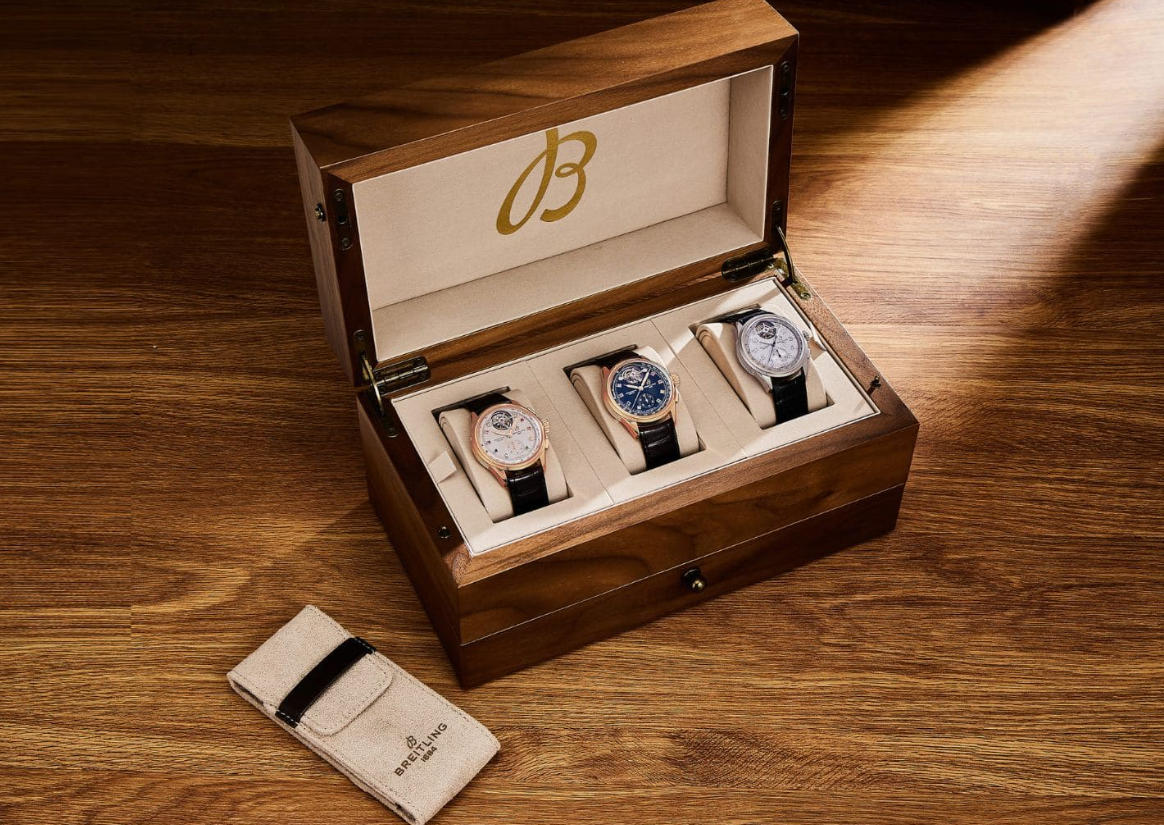
There are plenty of complicated Breitling watches, but the Premier B21 Chronograph Tourbillon 42 trilogy feels different from the usual aviation-inspired pieces most people associate with the brand. Rather than leaning on instrument-watch history, these three watches use precious metals, coloured stones, a meteorite dial and a prominently displayed tourbillon to show a far more decorative side of Breitling. The set brings together three versions built around the same 42mm Premier B21 architecture. One represents daylight, another the night, while the third turns to meteorite for a much older interpretation of time. The idea could easily become theatrical, yet the underlying watches remain recognisably Premier thanks to their case shape, chronograph layout and the tourbillon sitting high on the dial. For readers who follow super clone watches UK, this is also an interesting release for another reason. A complicated design like the Premier B21 exposes the difference between simply copying the appearance of a luxury watch and reproducing its proportions, dial construction and mechanical character convincingly. A Breitling Premier B21 super clone watch therefore has far more details to get right than a conventional three-hand model.
Three Watches With One Mechanical Foundation
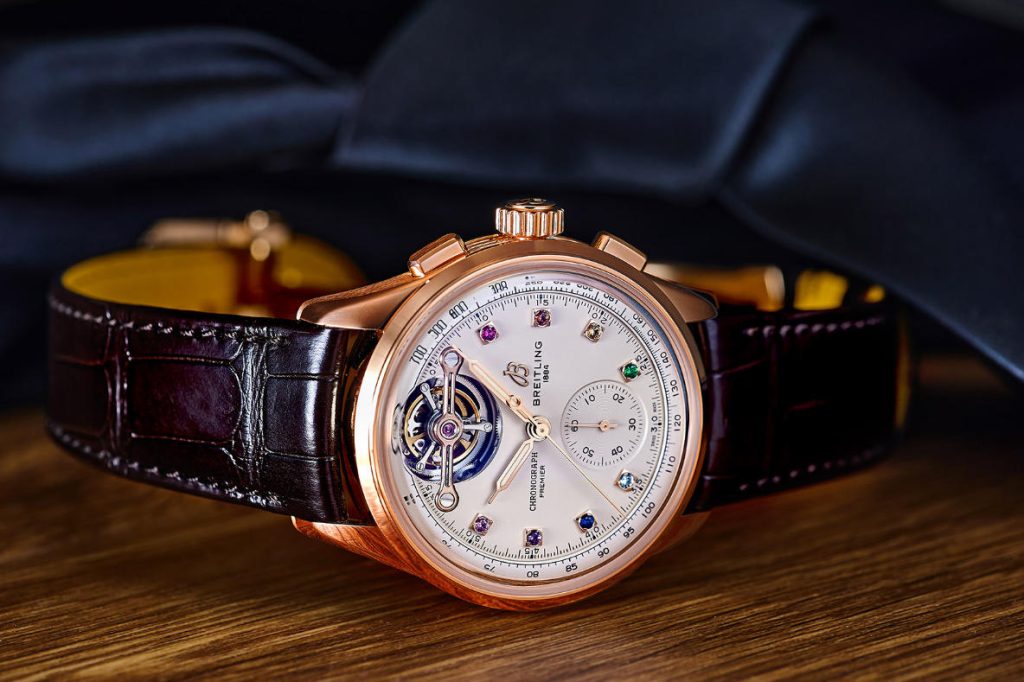
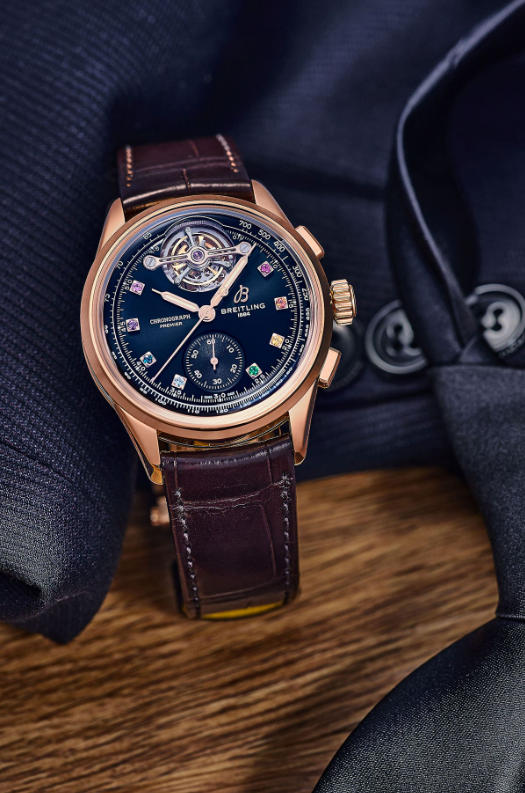
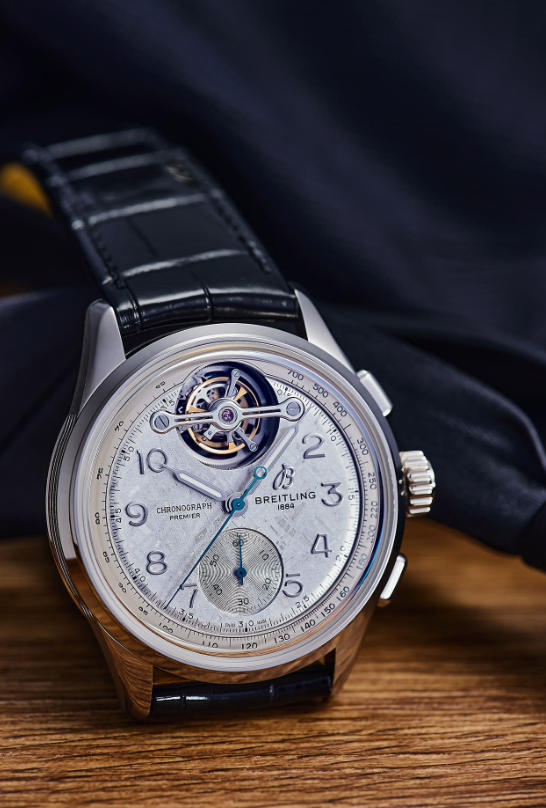
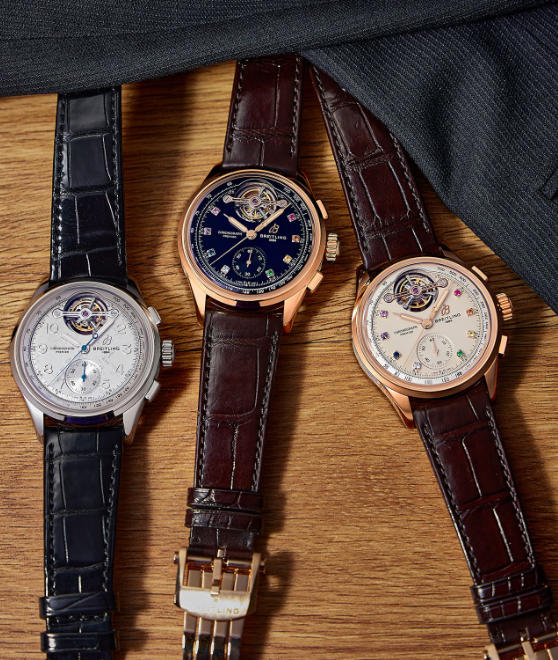
At first glance the three watches seem dramatically different, but their personalities come mainly from dial treatment and case material rather than a completely different underlying design. The first watch uses a light dial with eight coloured sapphire and ruby hour markers. Against the pale background, the stones provide just enough colour to make the watch feel unusual without hiding the architecture of the chronograph. Its 18K red-gold case and brown alligator strap soften the appearance further. The second version takes almost the opposite approach. A black dial provides the background for the same arrangement of coloured stones, giving them considerably more visual contrast. The red-gold case remains, but the darker dial changes the personality of the watch. It feels less formal and more dramatic, particularly around the open tourbillon at 12 o’clock. The third watch is the one I would spend the most time looking at. Its dial is made from Muonionalusta meteorite, with the naturally formed Widmanstätten pattern creating a surface that cannot be duplicated exactly from one dial to another. The cooler appearance is matched with an 18K white-gold case and black alligator strap. That natural variation matters when discussing a meteorite dial Breitling super clone. A printed pattern may resemble meteorite in photographs, but it does not automatically reproduce the texture, irregularity and way genuine meteorite reacts to changing light. It is one of the areas where close inspection tells you far more than a seller’s use of the words “super clone”.
The Premier Case Is More Important Than It Looks
Much of the attention naturally goes to the tourbillon and unusual dials, but the case is equally important to the character of this watch. The Premier B21 measures 42mm across and is approximately 15.25mm thick. Those dimensions give it considerable presence, but this is not meant to look like a rugged Breitling dive watch. The smoother case, fixed bezel, curved crystal and traditional leather strap keep the proportions closer to a complicated dress chronograph. That distinction becomes particularly relevant when looking at a 42mm Breitling tourbillon super clone. Getting the diameter roughly correct is not enough. The thickness of the bezel, profile of the lugs, height of the crystal, position of the pushers and relationship between the case and strap all contribute to the way the Premier sits on the wrist. A super clone with an overly thick case middle or flat crystal can look convincing in a straight-on product photograph while appearing very different when viewed from the side. For this particular design, side-profile photographs are therefore just as useful as close-ups of the dial.
The Tourbillon Changes the Entire Dial
The defining mechanical feature is impossible to miss. Breitling positions the tourbillon at 12 o’clock, allowing it to become part of the face of the watch rather than something hidden behind the caseback. This arrangement gives the Premier B21 an unusual visual balance. Traditional chronograph information sits lower on the dial while the rotating tourbillon cage dominates the upper section. It is technically complicated, but visually the layout remains fairly easy to understand. Breitling developed the B21 automatic movement with Manufacture La Joux-Perret. It combines a chronograph and tourbillon, operates at 28,800 vibrations per hour and provides approximately 55 hours of power reserve. The movement is COSC certified, while a sapphire display back allows much of its architecture to remain visible. This is where the term super clone needs some perspective. There is no universal technical standard defining what a “super clone movement” must contain. Two watches advertised with exactly the same phrase may use completely different mechanical constructions. With a Breitling B21 chronograph tourbillon super clone, I would therefore look beyond the label and ask a few simple questions. Does the tourbillon actually operate as shown? Is the chronograph functional? Does the subdial layout correspond to the original? How closely does the visible movement architecture resemble the B21 through the caseback? Those details are far more useful than a generic quality grade.
Why the White Dial Version Works So Well
Of the two gem-set pieces, the white dial is probably the easiest to understand immediately. The coloured stones have room to stand out, but they do not dominate the entire watch. The combination of red gold, a light dial and a brown strap also feels appropriate for the Premier family. There is a vintage warmth to it, even though nothing about a modern tourbillon chronograph with rainbow gemstones could reasonably be called restrained. For a super clone interpretation, colour accuracy would be one of the first things I would examine. Red-gold plating can shift too far toward pink or copper, while imitation stones can become overly saturated. On a watch where the palette is such a large part of the design, small colour differences become surprisingly obvious. A convincing red gold Breitling Premier super clone needs the dial, case and strap to work together. Matching one element well while getting the other two wrong will not create the same overall impression.
The Black Dial Has a Completely Different Character
Move to the black dial and the coloured markers suddenly look brighter. It is still fundamentally the same watch, but it feels more contemporary and a little more aggressive. I also think the darker background makes the tourbillon opening easier to appreciate. There is more contrast around the mechanics at 12 o’clock, while the red-gold case forms a warm frame around the dial. This version is a useful reminder that the quality of a super clone dial cannot be judged from colour alone. The depth of the printing, alignment of the markers, dimensions of the subdials and finishing around the tourbillon aperture all matter. On a relatively simple watch, a small printing difference can disappear on the wrist. On the Premier B21, the eye has several geometric reference points at once, so poor alignment becomes easier to spot.
The Meteorite Version Is the Hardest One to Imitate Naturally
The meteorite model is the least colourful of the three, but to me it is the most interesting. The Muonionalusta material gives every dial its own naturally formed pattern, meaning two genuine examples will never be visually identical. That makes the idea of a super clone particularly complicated. A manufacturer can reproduce the general silver-grey appearance and imitate a Widmanstätten-style pattern, but that does not make the material or its structure equivalent to the original. When looking at a Breitling Premier meteorite dial super clone, I would pay attention to whether the pattern looks naturally irregular or simply repeats across the surface. I would also look closely at the transitions around the subdials and tourbillon opening. Those areas are often more revealing than the centre of the dial. The white-gold appearance is another challenge. Unlike red gold, white gold is visually less obvious from a distance, so surface finishing becomes more important. Polished and brushed areas need to meet cleanly, and the case should not have the overly bright chrome-like appearance sometimes seen on cheaper replicas.
The Caseback Deserves as Much Attention as the Front
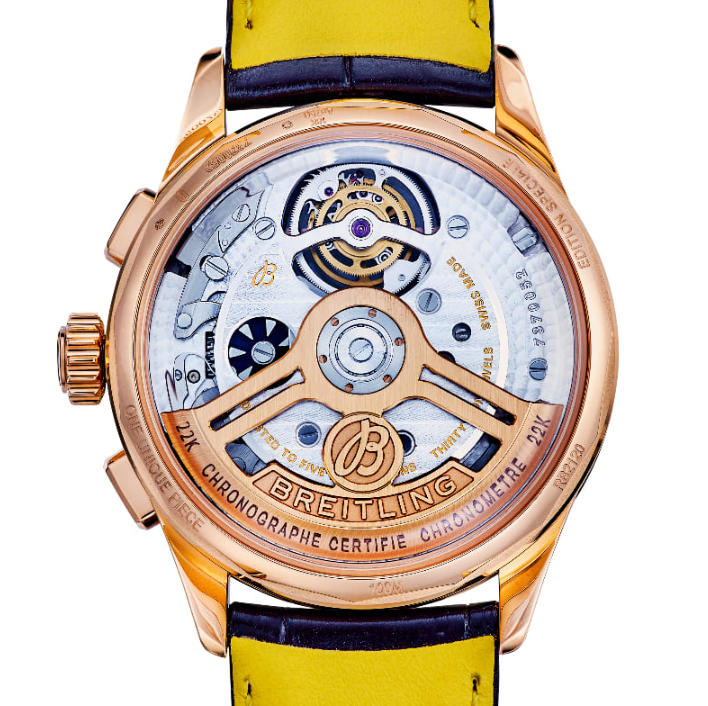
Many replica watches are designed primarily to look convincing from the dial side. That approach becomes much harder with the Premier B21 because Breitling deliberately exposes the movement through a sapphire caseback. The genuine watch lets you see the automatic movement, contrasting gold components and the reverse side of the tourbillon. Consequently, the back of a super clone is not a secondary detail. If I were comparing examples, I would look at the rotor shape, bridge layout, screw positions, engraving depth and the amount of empty space visible through the sapphire. Decorative plates can sometimes make a movement appear similar at first glance, but the illusion often disappears once you compare the architecture carefully. This is why readers browsing our Breitling super clone watches coverage should treat movement photographs as an important part of the comparison rather than relying only on front-facing images.
Super Clone Does Not Mean Every Detail Is Identical
The phrase “super clone” has become common in the replica watch market, but it is still a marketing description rather than a recognised watchmaking specification. That matters more with an unusual piece such as the Premier B21. A watch can have the correct 42mm diameter and a broadly similar dial while differing considerably in thickness, movement architecture, chronograph operation or gemstone setting. Instead of asking whether a watch is simply a super clone, I find it more useful to break the comparison into separate areas:
- Case proportions: diameter, thickness, lug profile and pusher placement.
- Dial construction: marker alignment, printing, subdial depth and tourbillon aperture.
- Materials: appearance of the gold finish, stones and meteorite-style dial.
- Movement: tourbillon behaviour, chronograph function and visible architecture.
- Caseback: engraving, rotor design, bridge arrangement and finishing.
- Strap and clasp: taper, stitching, curvature and hardware proportions.
Those points provide much more useful information when judging a high quality Breitling Premier super clone than terms such as AAA, perfect or 1:1 on their own.
A Rare Breitling That Shows a Different Side of the Brand
The most appealing part of this three-watch set is that it does not feel like another variation on the Navitimer, Superocean or Chronomat. Instead, Breitling uses the Premier line to explore traditional complicated watchmaking in a much more decorative way. The daylight and night watches play with the same coloured stones in completely different surroundings, while the meteorite version replaces that colour with natural texture. Put together, the three watches make sense as a set without feeling like the same design repeated three times. Reports surrounding the special presentation describe the trio itself as a single worldwide set, making it very different from the normal production references within the wider Premier B21 family. That rarity is interesting, but I do not think scarcity is the main reason the watches deserve attention. For me, the real attraction is how many difficult elements Breitling has put into one design: precious-metal cases, unusual dials, a chronograph, a visible tourbillon and an open caseback. Each gives the watch another layer of character, and each also becomes another point that a super clone interpretation must reproduce convincingly.
The Breitling Premier B21 Chronograph Tourbillon 42 trilogy is extravagant, but it is not extravagant without purpose. The white dial feels warm and bright, the black dial provides considerably more contrast, and the meteorite version brings an entirely different texture to the set. More importantly, the B21 architecture underneath gives all three watches a genuine mechanical identity. The 42mm case, 100-metre water resistance, approximately 55-hour power reserve and combination of chronograph and tourbillon make this much more than a decorative dial exercise. From a super clone perspective, it is exactly the kind of watch that rewards careful inspection. A convincing photograph is only the beginning. The best Breitling Premier B21 super clone comparisons should examine case proportions, dial construction, tourbillon layout, movement appearance and caseback finishing together. That is ultimately what makes the Premier B21 so interesting to follow. Whether looking at the genuine trilogy or studying how the super clone market interprets it, this is a Breitling where the smaller details matter more the longer you look.